
A first look at FY25 remuneration data across the AIM 100, covering salary levels, pay mix, bonus measures and long-term share awards.
Remuneration is one of the governance topics boards and investors return to most often, yet reliable benchmarks for the UK growth market are hard to come by. Most pay surveys are built around the FTSE 350, where scale, structure and shareholder expectations look very different.
To help close that gap, we have pulled together early findings from the new remuneration dataset on the Addidat Platform. The figures below are based on FY25 company disclosures across the AIM 100, and are shown only where companies disclosed the data.
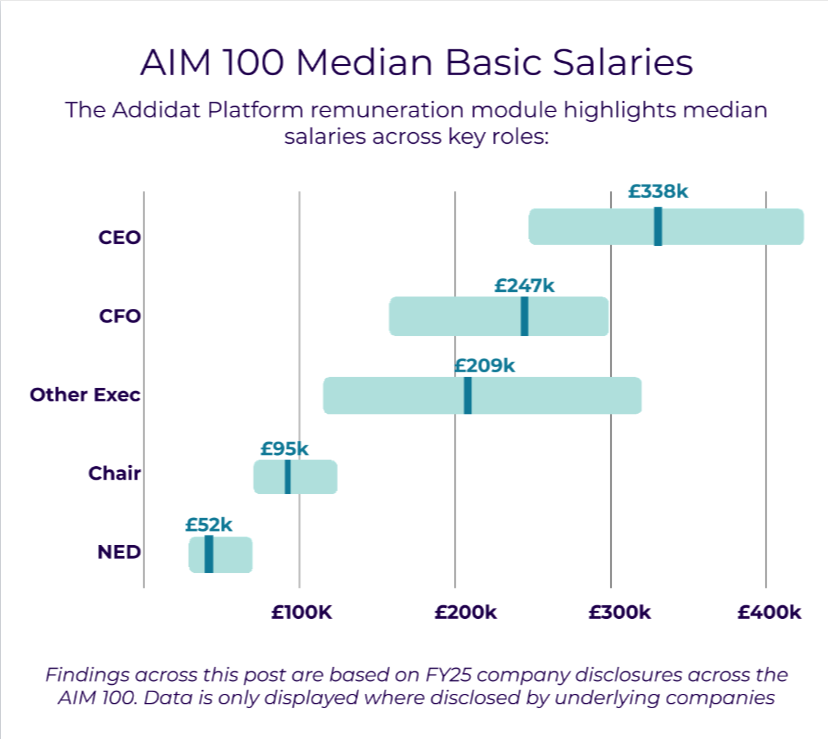
Median basic salaries
The ranges around each median are wide, particularly for CEOs, which reflects the spread of company size and complexity within the index. For remuneration committees, that makes a like-for-like peer group more useful than a single headline number.
Understanding the executive pay mix
Our data shows that salary makes up the majority of executive pay, at 53% of total compensation for CEOs, 56% for CFOs and 59% for other executives. Salaries outstripped bonuses across every executive role.
Bonuses add a meaningful but secondary layer, at around a fifth to a quarter of total pay. Median bonus paid was below 100% of salary for all roles: 87% for CEOs, 70% for CFOs and 56% for other executives. While bonuses remain an important component of executive remuneration, basic salary accounts for the largest share of total compensation across all three executive roles.
What bonuses are paid for
Bonus measures are closely linked to company performance. Profit and strategic company goals are the most common measures across all roles, followed by personal objectives, revenue and cash flow.
While financial performance remains central, our data also shows that non-financial measures are being incorporated into AIM 100 bonus schemes. ESG metrics feature in 18% of CEO bonus measures, while health and safety is separately identified in 9%.
This reflects an important consideration for boards, where non-financial measures are used, the focus should be on those that are most material to the business, its risks and its long-term strategy.
A short financial tie
Capturing and normalising award scheme data points to a limited long-term financial tie for AIM 100 executives:
32% of the AIM 100 set a shareholding requirement for their CEO and CFO (24% for other executives).
87% of AIM 100 CEOs hold share awards that have not yet vested (84% of CFOs, 91% of other executives).
1.4 years is the median time until a CEO's unvested awards pay out (1.6 years for CFOs and other executives).
So while most executives do hold unvested awards, the unit-weighted vesting period is short, and most have a financial tie of under two years. Combined with low take-up of shareholding requirements, this is an area investors may increasingly probe as they look for long-term alignment.
What this means for AIM companies
These early findings offer a useful picture of remuneration practices across the AIM 100. They also reinforce the importance of looking beyond headline salary figures to understand how executive pay reflects company strategy, performance and longer-term alignment. Boards reviewing remuneration this year may want to ask:
Is our salary positioning defensible against genuinely comparable AIM peers?
Do our bonus measures reflect our strategy, including any material ESG priorities?
Do our share awards and shareholding requirements give investors confidence in long-term alignment?
These are early insights, and we will share more as the dataset grows. If you would like to see how your company compares, please get in touch.
Visit www.addidat.com to book a call with our experts, see our client feedback, or view a demo video of the Addidat Platform.
For more of the data, see our AIM 100 remuneration carousel on the Addidat LinkedIn page.
Findings are based on FY25 public disclosures by companies across the AIM 100. Data is only displayed where disclosed by underlying companies.