
Gender Diversity in AIM Company Boards: 2026 Report
Click here to download the full report.
Addidat and Indigo: Independent Governance are pleased to share our fourth annual report on gender diversity in AIM company boards. In this report we use gender diversity as a proxy for wider board diversity as it is the only consistently reported metric currently available for AIM company boards.
Poor AIM board gender diversity is masked by FTSE350 success
Cognitively diverse boards benefit from stronger decision-making and visibly diverse and inclusive leadership can help attract top talent to support performance and growth. For these reasons alone, achieving real board diversity across UK business should be a market priority.
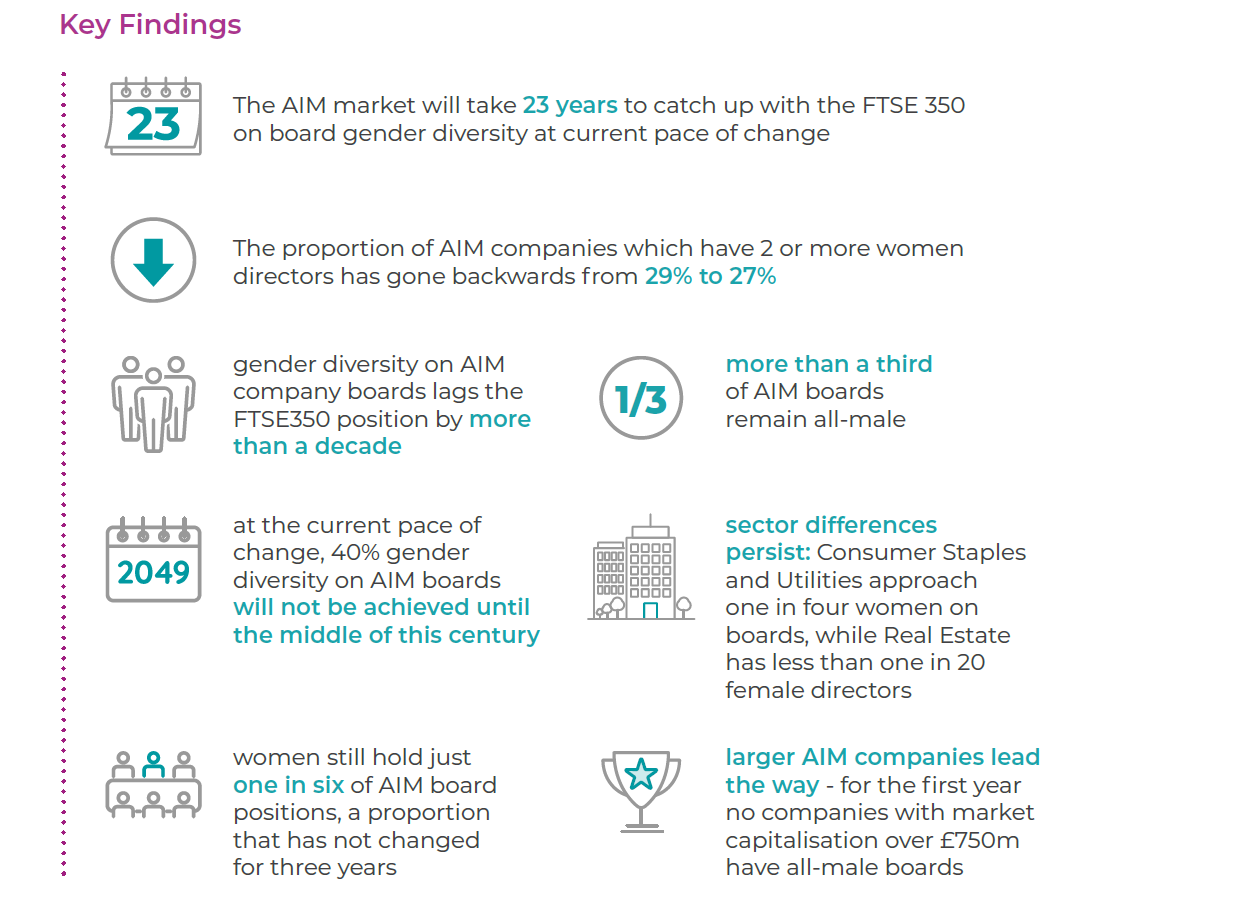
However, the stark reality is that the AIM market is more than a decade behind the FTSE350 in terms of the proportion of women directors appointed** and progress remains painfully slow. Addidat’s proprietary data shows that women still only hold 16.8% of AIM board seats, up only slightly from last year.
AIM companies need to more than double the current number of female directors to achieve the 40% main market target for women on boards. At the current pace of change, it will take until 2049 to reach 40% female representation, a level already achieved by FTSE 350 companies.
Many AIM companies are already leading the way, and their success shows what is possible. Our goal is to shine a light on the significant underrepresentation of women on AIM boards, highlight where commitment to gender diversity has already delivered results, and challenge the AIM community to come together to find a regulatory-light way to create positive change.
AIM’s approach to board diversity
The introduction of formal targets and reporting has worked well to spur change in the FTSE350 but, as we are seeing, this has not trickled down to smaller companies on AIM.
The less prescriptive nature of diversity expectations under the QCA Corporate Governance Code and AIM Rules is consistent with the AIM ethos of providing flexibility and limiting regulatory burdens. While the 2023 QCA Code refresh encouraged boards to consider diversity thoughtfully, the data set out in this report suggests that this has not yet been enough to change behaviours and outcomes. Greater commitment is needed to accelerate the creation of more diverse boards.
Although some AIM companies are yet to report under the 2023 Code, there is no evidence from Addidat’s data to indicate that AIM companies are starting to use naturally-occurring director recruitment opportunities to accelerate the achievement of gender balanced boards. If anything, the pace of change has slowed compared to that reported last year and we fear that a similar, or potentially even worse picture would be seen if we had the data to report on other forms of board diversity.
Moving beyond minimal representation
Despite more than 90% of AIM companies comprising four or more directors, nearly three-quarters of AIM boards have either no women or have only appointed one. To achieve meaningful diversity of perspectives, even smaller boards need at least two women directors, with at least one ideally in a leadership role that brings greater influence.
Those leadership roles, however, also remain heavily male-dominated; like last year, more than 72% of AIM boards have no women in CEO, CFO, Chair, or SID positions.
Why progress matters
Equity and inclusion is not only the right thing to do, it’s a smart business decision. Companies that introduce difference into their board composition benefit from the better decision-making that comes from bringing a broader range of perspectives to debates on key strategic matters. Moreover, having a diverse leadership team acts as a powerful signal of the inclusive culture of the organisation that can attract ambitious talent and inspire positive momentum in building the pipeline of next generation directors.
Celebrating gender balance where it exists
In Appendix A to this report we identify the 50 AIM listed companies which, according to Addidat’s data, met both the the 40% female board representation target that applies to main market listed companies and have at least one woman in a senior board role.
We welcome their leadership and congratulate them on their progressive approach to enhancing cognitive diversity and boardroom debate through the creation of a more gender-balanced board composition.
How can the AIM community create change?
Settings targets against which main market companies are required to report has worked well for larger listed companies, as demonstrated by the progress reported in recent years in the annual FTSE Leaders Review updates. But this may not be the right answer for AIM as a market with a deliberately lighter-touch approach to regulation.
In our conversations with some of the AIM companies with the most gender diverse boards, we have already started to gather some views on alternative ways of changing board composition to make AIM company boards more representative of women and others who can bring different perspectives to boardroom discussions. A selection of their valuable real-life insights are shared throughout this report.
We do not want to advocate a particular solution to improve board diversity in this report but would like to use this report to prompt a collaborative conversation across the AIM community about how to encourage change and the adoption of an equality, diversity and inclusion mindset by those who influence and control board recruitment
*According to the FTSE Women Leaders’ Review, women held 17.4% of FTSE350 directorships by 2014
**1.03% growth on average over the last 3 years based on Addidat’s proprietary data
